
The challenge
WhatsApp dominates personal messaging with over 3B users globally, but teams all around the world often use a mixture of WhatsApp, Slack, email and a host of other tools to coordinate work. In this project, I explored whether WhatsApp could fill a gap and credibly enter the team communication category and what it would need to change to do so. In essence, I tried to answer the question: Can WhatsApp turn the world's most familiar messaging behavior into a new category of work communication?
First, What is WhatsApp?
What is the product?
WhatsApp is a free, cross-platform instant messaging and voice/video calling app owned by Meta Platforms. It supports text messaging, voice messages, video messages, voice and video calls, file sharing, group chats of up to 1,024 people and Status, which are like stories.
What problem does it solve?
WhatsApp was built as an SMS replacement, solving the problem of expensive, limited, platform-dependent text messaging, as stated by WhatsApp itself on its About page. SMS has 160-character limits, no read receipts and poor media support. WhatsApp provides free, rich, reliable, cross-platform messaging tied to a phone number.
Who currently uses it?
Over 3 billion monthly active users across 180+ countries use it, making it the world's most popular messaging app (as reported by Meta in May 2025 and also cited on Wikipedia). It is the de facto standard for messaging in markets like India, Brazil, much of Africa, and across Europe and Latin America.
What do people love about it?
- Simplicity: Tied to your phone number, no account creation, no usernames (until the recent username reservation rollout in June 2026). Profile is just a name, photo, and short status.
- Cross-platform reliability: Works equally well on iPhone, Android, Mac, Windows, and web browsers.
- End-to-end encryption: All messages, calls, photos, and videos are encrypted.
- Rich media support: Full-resolution photos, videos, documents, stickers, GIFs, voice messages.
- Global reach and network effects: The sheer scale means almost everyone you know is already on it.
But what are its weaknesses at the moment?
- Meta ownership erodes trust: User sentiment has shifted from "trusted default messenger" to "grudgingly necessary Meta product." (Malwarebytes, Jan 2026)
- Privacy concerns despite encryption: An international lawsuit filed in Jan 2026 alleges Meta can store, analyze, and access private communications despite E2E encryption claims. (Bloomberg, Jan 25, 2026)
- Client-side security vulnerabilities: Researchers at Black Hat Asia 2026 warned that WhatsApp's E2E encryption protects servers but leaves users exposed to client-side spyware attacks, metadata leakage, and device enumeration. (Computer Weekly, Apr 2026)
- View Once bypass: A fourth bypass method for the View Once feature was discovered in March 2026; Meta declined to patch it, citing modified client use. (SecurityWeek, Mar 2026)
- Business messaging intrusion: Companies now use WhatsApp to promote services, flooding personal chat views with promotional messages. (Digital Trends, May 2026)
- Media compression: WhatsApp compresses photos and videos by default, reducing quality. (Digital Trends, May 2026)
- Account lockout issues: Aug 2026 saw mass account disabling events where users were locked out with no clear recourse. (TechCrunch, Aug 3, 2026)
- No significant revenue for Meta: WhatsApp Business Platform monetization remains modest relative to user scale; ads creeping into Status area. (Digital Trends, May 2026)
What are its core capabilities?
- Text, voice, and video messaging/calling (1:1 and groups)
- End-to-end encryption (Signal protocol)
- Cross-platform (iOS, Android, Windows, Mac, web)
- Group chats up to 1,024 people
- File and media sharing
- Status (ephemeral stories)
- WhatsApp Business (small business app and enterprise Cloud API)
- Channels (broadcast feature for businesses/creators)
- Meta AI assistant integration (LLaMA 4)
- Username reservations (rolling out June 2026)
- WhatsApp Plus subscription (cosmetic/organizational features, launched May 2026)
What is the company's current positioning?
"Simple, reliable, private messaging and calling for free, available all over the world." The company emphasizes privacy, simplicity, and global accessibility as core values.
What category does the market put it in?
Instant messaging / social communication platform. Competes with iMessage (1.3B users), WeChat (1.26B), Telegram (1B), Signal (70M), Viber (260M), LINE (217M), KakaoTalk (57M).
What does the company say its future is?
WhatsApp's trajectory points toward becoming a comprehensive communication and business platform:
- Business monetization: WhatsApp Business Platform for enterprise customer service and conversational commerce.
- AI integration: Meta AI assistant available in-app for questions and task completion.
- Creator/business broadcast: Channels feature for reaching large audiences.
- Premium features: WhatsApp Plus subscription for cosmetic and organizational features.
- Username system: Moving beyond phone-number-only identity.
- Parental controls: Parent-managed accounts for children's safety.
My approach to reframing WhatsApp
01 — The Market Opportunity
Could WhatsApp realistically win in the market as a team communication software?
Current Market Size & Growth
| Metric | Value | Source |
|---|---|---|
| Team messaging market (2025) | $25.4B | MarketIntelo, 2026 |
| Projected (2034) | $57.8B (9.8% CAGR) | MarketIntelo, 2026 |
| Team collaboration software (2025) | $40.2B | Grand View Research, 2026 |
| Projected (2033) | $85.2B (9.7% CAGR) | Grand View Research, 2026 |
| Instant messaging market (2026) | $78.4B | MarkWide Research, 2026 |
| Projected IM market (2035) | $173.1B (9.2% CAGR) | MarkWide Research, 2026 |
Why should WhatsApp take this opportunity?
WhatsApp has 3.3 billion MAU [DemandSage, 2026] and processes 100–150 billion messages/day [Axis Intelligence, 2026], yet generates only ~$1.18 ARPU/year vs. Instagram's $46.78 and Facebook's $206.59 [Axis Intelligence, 2026]. This is the single largest monetization gap in consumer tech.
The killer insight: WhatsApp is already the default work messenger for millions of small teams globally; it's just terrible at it. As Homebase noted, "a WhatsApp group is often the only channel that actually reaches them during a shift" [Homebase, 2026]. The product just needs to formalize what's already happening.
WhatsApp's WhatsApp Business API hit $2B ARR by Q4 2025 and is now at an annualized ~$3.54B run rate [Meta Q1 2026 SEC filing]. But current business tools are built for customer-facing messaging (B2B2C), not internal team collaboration (B2B). A dedicated "Teams" product captures the internal communication budget that small teams currently spend on Slack, Teams, or Discord.
SMBs represent ~90% of all businesses globally [OECD], and the overwhelming majority are micro-businesses with <10 employees. The beachhead segment likely represents 30–40% of total addressable market by volume but only ~10–15% by revenue.
Competitive Landscape
| Platform | Pricing | Free Tier | Key Strengths | Key Weaknesses |
|---|---|---|---|---|
| Slack | $7.25–$15/user/mo | 90-day history, 10 integrations | 2,600+ integrations, search, developer culture | Expensive at scale; no read-only users; 90-day history cap |
| MS Teams | $0 (bundled w/ M365) or $4/user/mo | Limited free | Deep Microsoft integration, meetings, compliance | Bloated UX, enterprise-heavy |
| Discord | Free / $2.99–$9.90/mo Nitro | Most features free | Always-on voice channels, free unlimited messaging | Gaming reputation, no threaded conversations |
| Signal | Free | Full app free | Gold-standard encryption, non-profit trust | ~40M MAU, no business features, no channels/bots |
| Telegram | Free / $4.99 Premium | Full app free | 1B MAU, 200K groups, bots, 2GB files | E2E encryption only in Secret Chats |
Slack's per-user pricing is structurally hostile to small teams. A 10-person team paying $8.75/user/mo = $1,050/yr just for chat. WhatsApp Teams will be at $4.99/mo flat = $60/yr. That's a 94% cost savings. (This is simply my hypothesis. Proper pricing research will have to be conducted).
Can WhatsApp Win?
In my opinion, yes, for the beachhead. WhatsApp's zero-install distribution (3.3B users already have it), mobile-first design, phone-number identity, and end-to-end encryption give it undeniable advantages for 2–20 person teams. Plus, many teams already use it for similar purposes around the world. It will struggle to displace Slack in 50+ person teams with established tooling. But the play is land-and-expand within the WhatsApp-native workflow, not feature-parity with Slack.
02 — Customer discovery
Who would benefit the most from a product like this?
Small teams that need fast, low-friction communication but find Slack/Teams overkill:
- Startup teams (2–15 people): Early-stage companies where everyone wears multiple hats. They don't have IT departments, don't need enterprise compliance, and communicate constantly across time zones. WhatsApp is already their default for personal communication.
- Agencies and freelance collectives: Creative teams, marketing agencies, and consulting pods of 3–12 people who collaborate with clients and each other. Need fast, informal communication with external parties.
- Remote-first micro teams: Distributed teams of 2–8 people who work asynchronously. Need reliable cross-platform messaging without onboarding friction.
- Student organizations: University clubs, Greek organizations, and student government bodies with 5–20 active members. Already use WhatsApp for personal coordination; would benefit from separation of personal and organizational communication.
- Family businesses and small retail: Mom-and-pop shops, family restaurants, small retail operations with 3–10 employees. Owner uses WhatsApp for everything; wants light separation of business and personal messages.
Pain Points
| Pain Point | Detail | Source |
|---|---|---|
| Slack pricing | "The pricing structure kills our use case" — passive readers cost the same as active users | r/Slack, multiple threads |
| Slack 90-day limit | Free plan only shows 90 days of history | Slack pricing page |
| Tool fragmentation | "Half my day is just switching between apps" | r/SaaS, 2025 |
| WhatsApp Business limits | 5 devices max, no assignment tracking, no chat routing | Respond.io, BoldDesk |
| Enterprise bloat | MS Teams has too many features for small teams | StackPicks, 2025 |
| Onboarding friction | "We can't get people to adopt a new tool — everyone already has WhatsApp" | Startup forums |
03 — Beachhead
Which team segment should WhatsApp target first?
Ideal Customer Profile (ICP)
| Attribute | Detail |
|---|---|
| Company size | 3–15 employees |
| Industry | Marketing/creative agencies, dev shops, consulting, design studios, startups |
| Revenue | $50K–$5M ARR |
| Location | India, Brazil, US (remote-first), UK, Southeast Asia |
| Current tools | WhatsApp groups + Google Docs/Sheets + occasional Zoom or Google Meet |
| Tech sophistication | Low-medium; no IT department, no DevOps |
| Budget for comms tools | $0–$200/month |
| Decision maker | Founder/CEO or ops lead |
| Trigger event | Just hired employee #3–5; existing WhatsApp groups are getting chaotic |
Jobs to Be Done (JTBD)
“When my small team needs to coordinate on our work or client work, help me keep all conversations, both internal and with clients, in one place I already use, so I can respond fast without switching apps or paying per person.”
Supporting JTBDs:
- “When a new team member joins, help me get them productive immediately without downloading a new app”
- “When I need to assign a client conversation to the right team member, help me do that without duplicating replies”
- “When I need to find a past conversation or file, help me search across all team chats”
- “When I need to share a quick update with the whole team, help me do it reliably without email lag”
04 — Product strategy
What should WhatsApp Teams actually be?
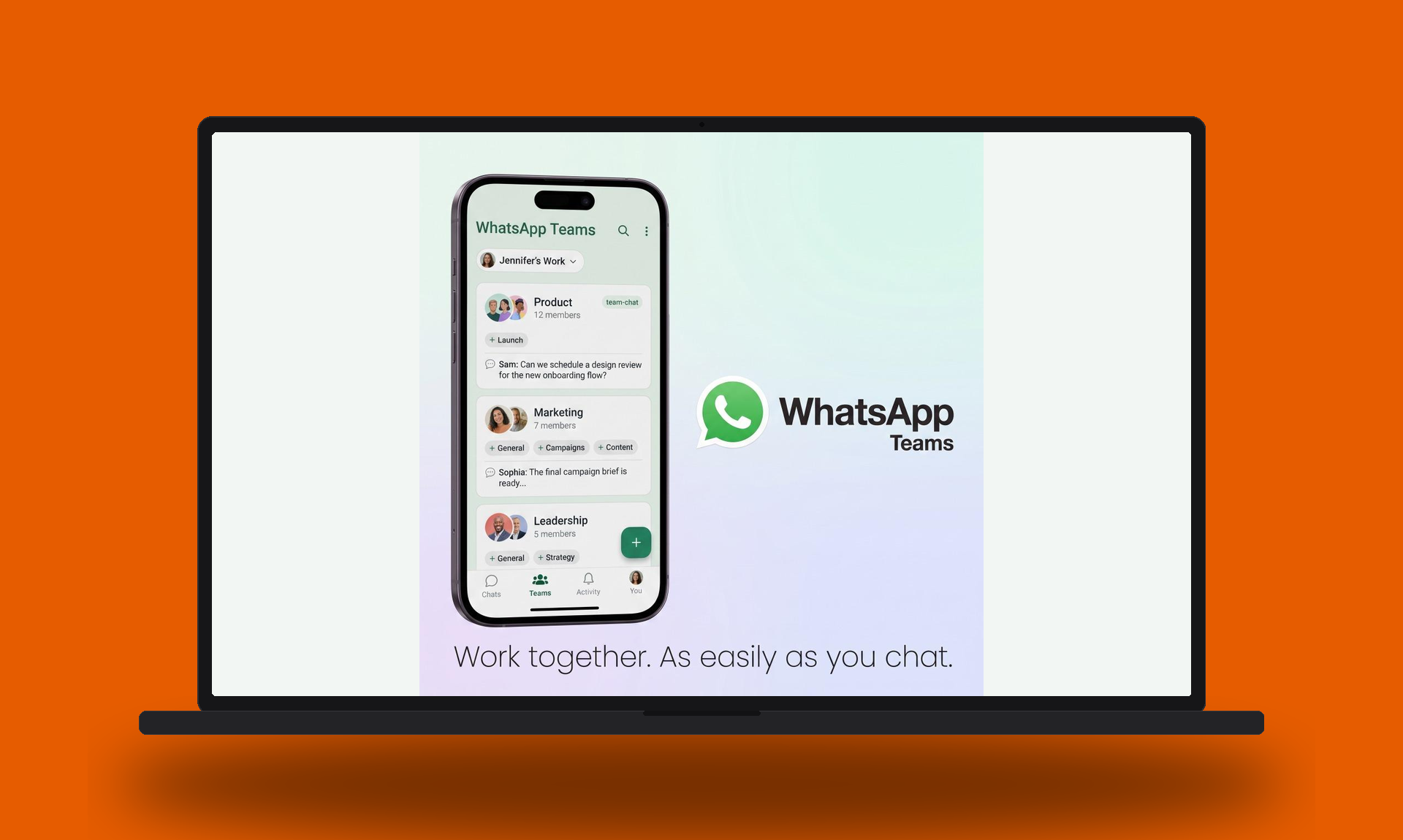
My recommendation is to extend functionality. That is, create a new workspace mode within the existing WhatsApp app. Think "WhatsApp Workspaces" toggled from the same app.
Why not a new app? Because the #1 advantage is zero-install; a separate app kills this.
Features that could be added to the Workspaces:
- Channels & Threads for structured topics
- Chat Assignment & Ownership tracking
- Search Across Workspaces & Better organization
- File Sharing over 2GB for elevated plans
- Voice/Video Call Huddles for Teams and Call scheduling features
- End-to-End Encryption for Businesses
- Lightweight integrations with key tools (Gmail, Google Drive, Notion, etc.)
Suggested Pricing
| Plan | Subscription | Includes |
|---|---|---|
| Team | $4.99/mo flat | 1 Workspace, up to 25 members, advanced search, chat assignment |
| Business | $14.99/mo flat | Unlimited members, unlimited storage, API access, admin analytics |
Why flat-rate: Slack's per-user model is its #1 competitive vulnerability. A 10-person team at $4.99/mo flat vs. $87.50/mo on Slack = 94% cost savings.
05 — Positioning
Why WhatsApp Teams instead of Slack or others?
Competitive Alternatives Out There
- Slack — the gold standard for team messaging
- Microsoft Teams — free if already on M365
- Discord — free, used by startups
- Consumer WhatsApp groups — the status quo (free, broken)
- Telegram — free, feature-rich
Unique Attributes of WhatsApp Teams
- 3.3B users with the app already installed — zero distribution friction
- Mobile-native from day one — not a desktop app that added mobile
- End-to-end encryption by default — not opt-in
- Phone number identity — no new username/password
- Cross-platform consistency — works identically everywhere
- Personal + work in one app — context switching without app switching
Value this Product Provides
- Zero onboarding cost — teams productive in minutes, not days
- Instant network effects — every contact already reachable
- Lower total cost of ownership — no per-user pricing, no training, no IT setup
- Works for frontline workers — no email/laptop required
Best-Fit Customers for this Product
Small teams (2–20) who already communicate on WhatsApp, can't justify per-user pricing, don't need deep integrations, and want simplicity over feature-richness.
Market Frame for our Customers
Primary: Team messaging / lightweight collaboration.
“For small teams that have outgrown WhatsApp group chats but don't need complex workplace software, WhatsApp Teams is a lightweight team communication workspace that brings the familiarity and immediacy of WhatsApp to work.”
Suggested competitive positioning:
“Slack gives teams powerful collaboration tools. WhatsApp Teams gives small teams the simplest possible way to work together.”
Message House
Work together. As easily as you chat.
| Pillar | Message | Proof Point |
|---|---|---|
| Familiar | Your team already knows how to use it. No new communication system to learn. No new app. No new login. No training. | 3.3B users; #1 messaging app in 100+ countries |
| Focused | Keep work separate from your personal conversations. One WhatsApp. A dedicated space for work. | Separate Workspace accounts |
| Work-Smart Organization | Channels, assignment, search, everything your team needs, nothing it doesn't. | Solves #1 WhatsApp Business limitation |
| Private by Default | End-to-end encrypted. Your work conversations stay yours. | Default E2E encryption; stronger than Telegram |
| Connected | Stay close to your team wherever they work. Mobile-first, cross-platform communication. | Mobile-first. Easy access platform |
Conclusion
WhatsApp doesn't need to become another Slack to thrive in this market category. It needs to solve a problem Slack was built to solve in a way only WhatsApp can. The research I undertook suggests that an opportunity exists between the informality of consumer group chats and the complexity of traditional workplace collaboration tools.
WhatsApp Teams addresses that social vs work gap by turning an existing behavior into a purpose-built work experience. That is, keeping WhatsApp's familiarity, speed and accessibility while introducing the structure needed for teams to collaborate effectively on it.
My strategic recommendation is therefore not to compete with Slack feature-for-feature, but to own lightweight team communication for teams that have outgrown the group chat but aren't ready for heavyweight workplace software.
The opportunity isn't to make WhatsApp more like Slack. It's to make work feel as easy as WhatsApp.
This is an independent PMM case study based on public market research, industry benchmarks, and product strategy. WhatsApp is a trademark of Meta Platforms, Inc. Product decisions, positioning, messaging, and strategic recommendations are my own.